- 1
STORAGE — Store flat on a level surface. Do not store on asphalt or in areas prone to excessive heat. Use the pallet shroud or a tarp when storing outside. Keep the protective film on during installation — fastening through the film helps keep the surface clean. Remove the film only before filling nail holes or inserting plugs, and before heat bending.
- 2
NON-STRUCTURAL — Ply Gem PVC Trim is NOT for load-bearing applications. Cellular PVC is more flexible than wood and must never be substituted for dimensional lumber where structural support is required.
- 3
EXPANSION GAPS — Cellular PVC expands and contracts with temperature. Leave an expansion gap per every 18' of run: no gap at 90°F or above; 1/8" at 50°F–90°F; 3/16" below 50°F. Ideally install long runs at 60–70°F. Short pieces (window/door casings) should be installed with tight joints. For continuous runs of 36' or more, design in a proper expansion joint. For board-to-board connections on long runs, use a ship lap or 45° miter joint sealed with PVC cement. Never completely fill expansion joints with sealant. On south-facing or direct-sun exposures, reduce fastener spacing to 12" OC to further restrict movement.
- 4
FASTENERS — Use stainless steel nails or screws (preferred) or galvanized nails or screws. Do NOT use staples, brads, wire nails, fine-threaded wood screws, or ring-shank nails. Nail guns are acceptable — do not over-drive. Fastener heads should be flush or slightly indented. Cortex® Screw Plug System and OSI® TrimTeQ System are the recommended fastening methods.
- 5
FASTENER PLACEMENT — No closer than 3/4" from the end of a board, no further than 2" from the end. Fasteners must penetrate solid wood substrate at least 1-1/2". Into 1/2" OSB, 1" penetration is acceptable. When installing over foam sheathing, fasteners must still reach solid substrate a full 1-1/2". If framing members are greater than 16" on centre, provide additional backing.
- 6
FASTENER QUANTITY — All products fastened 16" OC in the field. Per-width minimums: Trim boards 5/8"+ — 2 fasteners for 4" & 6" wide (min. 2-1/2" nail); 3 fasteners for 8" & 10" wide; 3–4 fasteners for 12" wide. Skirt boards 1" — 2 fasteners for 6" wide; 3 for 8" wide (min. 2-1/2" nail). Outside Corners 1" — 2 fasteners for 4" & 6" wide (min. 2-1/2" nail). Inside Corner 1-1/2" — 2 fasteners (min. 3" nail). Sheets 1/2" or less — 16" OC horizontal, 6" OC vertical, 4" OC at perimeter (min. 2" nail). Sheets 5/8"+ — same pattern, min. 2-1/2" nail.
- 7
PAINTING — Painting is not required for protection, with one exception: the 1/2" Notched Bead Board must be painted. Surface must be clean, dry, and free of chalk, grease, oil, dirt, mold, and mildew before painting. Use 100% acrylic latex formulated for vinyl. Scuff-sand with 100–120 grit or a Scotch-Brite scrub sponge. Verify whether the paint manufacturer requires primer. For colours with an LRV below 55, use heat-reflective paint such as Sherwin-Williams® VinylSafe™. Do NOT paint post wraps with dark colours (L values 56–0) without heat-reflective paint — heat build-up can cause warping.
- 8
CUTTING — Use carbide-tipped blades with 32 teeth or more. Avoid blades designed for plywood or metal. Cut in an open, ventilated area. Wear safety glasses and a dust mask. Do not burn. For drilling, use standard woodworking bits — not bits designed for rigid PVC — and clear shavings frequently to prevent heat build-up. For routing, use a sharp carbide-tipped bit; go over the cut a second time if needed and finish with 320-grit sandpaper.
- 9
FILLING NAIL HOLES — Remove the protective film before filling nail holes. Use Cortex® or TrimTeQ plugs made from actual Ply Gem Trim material for a perfect colour-matched, caulk-free finish.
- 10
HEAT BENDING — Cellular PVC can be formed into curved shapes using heat blankets, convection ovens, strip heaters, or radiant heaters. Apply heat approximately 3 minutes per 1/4" of thickness; always heat both sides simultaneously. Always wear protective gloves — hot PVC causes severe burns. Remove protective film before heating. Not recommended for woodgrain-finish boards or boards wider than 6". Contact Heatcon, Inc. (Seattle): 206-575-0815. Alternatively, 4'×8' sheets can be used to create arches and custom shapes without heat bending.
- 11
ADHESIVES — Use two-component PVC adhesives: Extreme Adhesive PVC TrimWelder™ (Fast Cure, Slow Cure, or White Hot) or Bond & Fill® Structural (Fast Cure, Slow Cure, or Quick & Easy). Do NOT use silicone caulks or wax-based nail putties. One-part PVC cement is acceptable but offers less working time and bond strength. Mechanical fasteners are always required — never use adhesive alone to attach trim to substrate. Secure bonded joints with fasteners on each side of the joint.
- 12
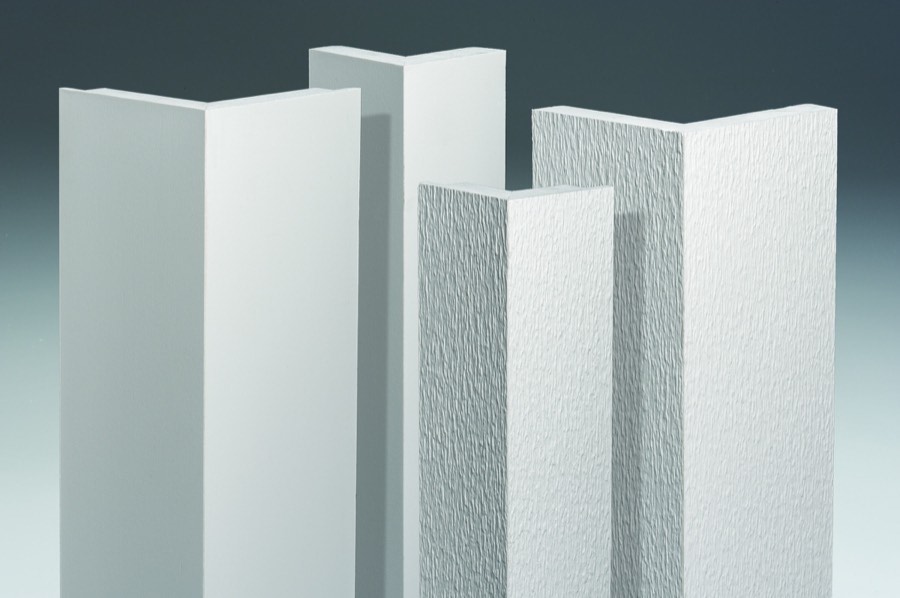
OUTSIDE CORNERS — Leave at least 1/8" gap between the top of the corner and the underside of the eave for expansion; allow 1/4" per 18' for longer runs. For vinyl siding, the bottom of the corner should extend 3/4" below the starter strip. Do not nail through the J-notch opening. Flash corners full height with a piece of trim coil bent 90° with two 10"-wide legs, overlapping at the top.
- 13
POST WRAPS — Apply a 1/8" bead of PVC adhesive along mitered corners (full length); apply a 1/16" bead in the snap-lock joint — excessive adhesive in the snap-lock may cause a visible sink line. Snap panels together ensuring tight closure along the entire joint. Remove film and tape after adhesive has set. Do not paint post wraps dark colours (LRV < 55) without heat-reflective paint.
- 14
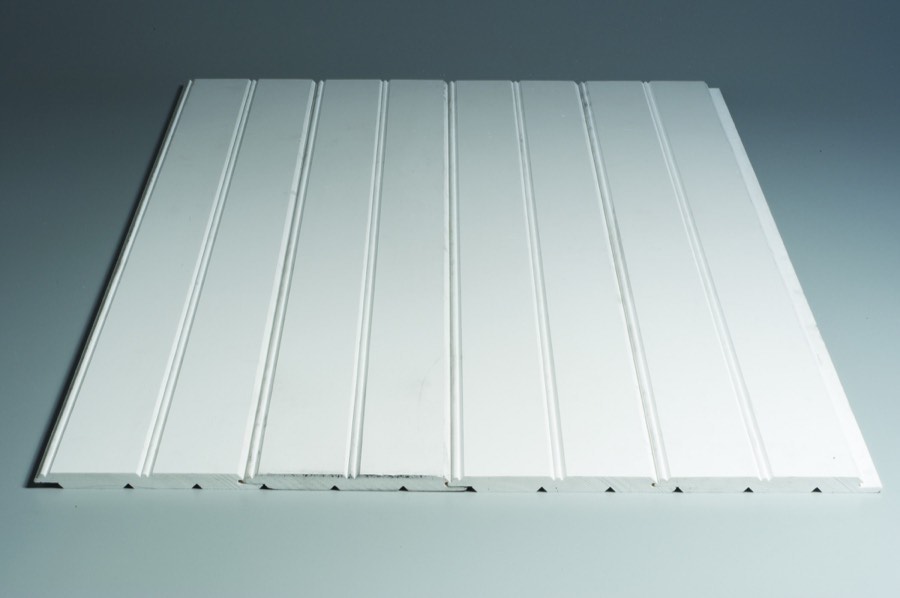
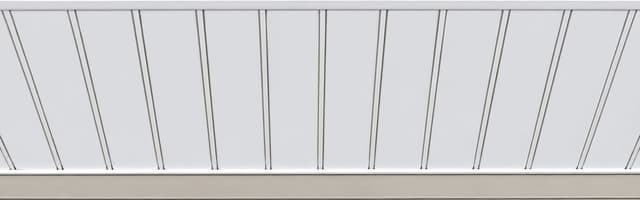
SPANNED APPLICATIONS (BEAD BOARD / SOFFITS) — Bead Board must cross ceiling joists at 12" or 16" OC. For spans greater than 16" OC, install a 1/2" plywood or OSB backer with construction adhesive. In hot climates, spans greater than 12" OC require a backer or use of the 1/2" Moulding Bead Board. When temperature is 40°F or below, do not span more than 12". Must be painted after installation to reduce dirt accumulation.
- 15
MAINTENANCE — Clean with a soft bristle brush and mild soap and water. Test any cleaner on an inconspicuous area before general use. For stubborn stains or dirt in surface cells, use a nylon brush.