
LP SmartSide and CanExel: What Engineered Wood Siding Warranties Really Cover (2026)
Key points
- LP SmartSide pays 100% of material and labour for 5 years, then prorates the material only across the remaining 45
- The CanExel finish warranty drops 18 points a year from year 6, so it is down to 10% of its value by year 10
- Engineered wood installs at 9 to 14 CAD per square foot in Ontario, roughly a quarter below fibre cement
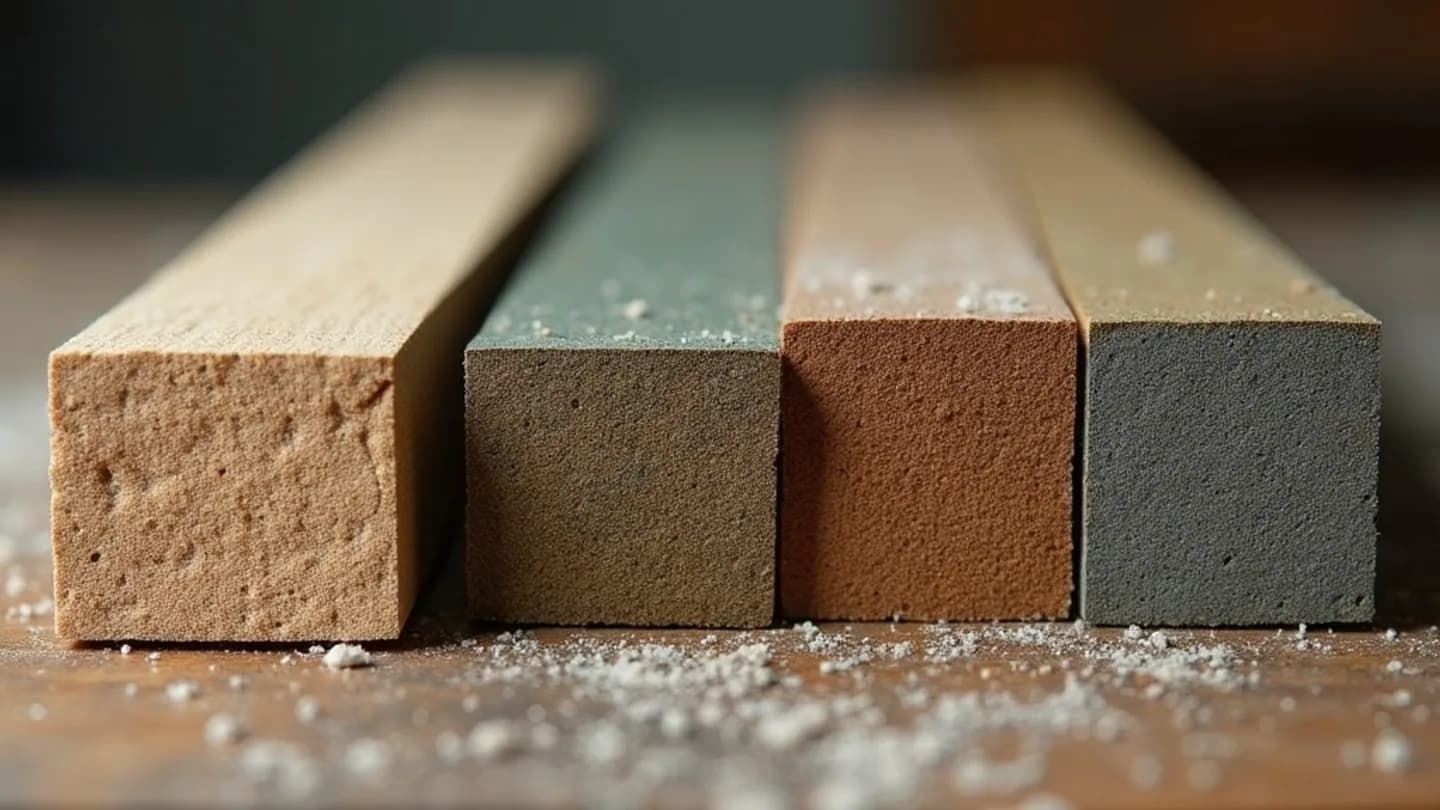
Four boards sit on the same rack at our Newmarket counter, and every one of them is sold as engineered wood siding. One is LP SmartSide lap, built from compressed wood strands. One is CanExel, built from high density fibreboard. One is a WPC facade panel, half wood flour and half polymer. The fourth is Allura, which contains no wood at all. They are not variations on a theme. They are four different materials that happen to share a shelf, and they fail in four different ways.
The fastest way to tell them apart is not the brochure. It is the warranty. A warranty is the one document where a manufacturer writes down, in numbers it is contractually bound to, how long it expects its own product to survive and which part it expects to go first. This guide reads those documents instead of the marketing. If you want the wider material picture first, start with our complete guide to vinyl siding in Ontario and come back for the engineered wood detail.
What Is Engineered Wood Siding, and Why Are There Four Kinds?
Engineered wood siding is a category name covering any cladding built from wood broken down and rebonded rather than sawn. In our catalogue it splits four ways: treated engineered strand (LP SmartSide), high density fibreboard (Maibec CanExel), wood plastic composite (our WPC panels), and fibre cement (Allura), which sits in the same aisle without containing any wood at all.
All four sit together in our engineered wood and fibre cement range, and they behave differently on a wall because they are held together differently.
Watch: the four substrates side by side, what each warranty really pays, and the install rules that cancel it. Strand board is large flat wood flakes bonded in resin, so it keeps some of the grain structure and most of the impact tolerance of solid wood. Fibreboard is wood milled down to fibre and pressed to a uniform density, which is what lets CanExel take a deep factory finish and a crisp embossed grain. WPC is wood flour suspended in polymer, so it stops behaving like wood entirely. Fibre cement is Portland cement with cellulose, and it belongs to the masonry family.
| Substrate | Product we stock | Nominal thickness | Finish as delivered | Headline warranty |
|---|---|---|---|---|
| Treated engineered strand | LP SmartSide | 0.315 in (38 Series), 0.375 in (76 Series) | Primed, paint on site | 50 yr prorated, 5 yr full |
| High density fibreboard, 960 kg/m³ | Maibec CanExel | 3/8 in | Factory finished, 18 colours | 25 yr substrate, 15 yr finish |
| Wood plastic composite | Pro Materials WPC panels | 0.78 in to 1.00 in | Co-extruded colour | 20 yr |
| Fibre cement, 1,300 kg/m³ | Allura | 5/16 in lap | Primed or Spectrum finished | 30 yr transferable |
Thickness is the spec that surprises people. The three cladding families contractors actually cross shop, LP SmartSide, CanExel and fibre cement lap, all land within a sixteenth of an inch of each other. The WPC facade panels are roughly three times thicker, because they are not lap siding at all. They are a rainscreen panel that spans differently and hangs differently.
That near tie between LP SmartSide 76 Series and CanExel at 0.375 inch hides the more useful number. LP rates the 38 Series to framing at a maximum of 16 inches on centre and the 76 Series to 24 inches. Six hundredths of an inch of extra substrate buys eight inches of stud spacing, which is a framing decision, not a finish decision, and it needs to be made before the walls go up.
Why the Warranty Is the Most Honest Spec Sheet You Will Read
A siding warranty is almost never a flat term. It is a short window of full coverage followed by a proration schedule that eats the value at a published rate. A "25 year warranty" on engineered wood typically means five years of real protection and twenty years of a declining material credit with no labour attached.
Read the two documents side by side and the difference is stark. LP SmartSide pays 100 percent of material and labour for five years, then prorates the material portion only across the remaining forty five. Maibec's CanExel warranty is more specific and, to its credit, more transparent: years one to five pay material and labour at an independent estimator's rate, then years six to twenty five pay the cost of a similar wood based siding product with no labour, reduced 5.0 percent per year until it reaches zero.
The finish warranty is where it gets sharp. CanExel covers the factory coating for fifteen years against cracking, peeling, chipping and colour fade beyond DE5. But after year five it declines at 18 percent per year to the end of year ten, then at 2 percent per year to the end of year fifteen. By year ten the coverage is down to 10 percent of its value. The last five years of that fifteen year headline are worth almost nothing.
- 100% covered
- Prorated
- Rate not published
- LP SmartSide50 years, prorated after year 5
- CanExel substrate25 years, less 5 points a year
- CanExel finish15 years, less 18 then 2 points a year
None of this makes either product a bad buy. It makes the headline number a poor way to compare them. What a warranty schedule really tells you is where the manufacturer expects trouble, and both of these tell the same story: the substrate is the confident part, and the years right after installation are when a claim is worth filing.
Two clauses are worth reading before you spec CanExel on a northern job. The warranty applies in Canada below the 55th parallel only, and Maibec sells a separate range approved for the Great North above it. It also defines buckling precisely, as 1/4 inch or more out of plane over a distance no greater than 16 inches between studs, which means ordinary waviness from crooked framing is explicitly not a claim.
What Does LP SmartSide Actually Buy You?
The substrate is the product. LP SmartSide engineered wood siding starts as wood strands coated individually with waxes, adhesive resins and zinc borate through the SmartGuard process, then bonded under a resin saturated overlay. The point of treating each strand rather than the finished board is that the decay and termite protection runs to the core, so a cut end is as protected as the face.
Three specs matter more than the rest on an Ontario job:
-
16 foot boards. Against the 12 foot standard for CanExel and fibre cement, that is a quarter fewer end joints on every course, and every joint you do not cut is one you do not have to flash and seal.
-
Framing tolerance. The 38 Series runs to a maximum of 16 inches on centre, the 76 Series to 24 inches. On a 24 inch stud layout the 38 Series is simply not an option.
-
Hail. The warranty covers hail damage up to 1.75 inches in diameter, which is a rare thing to see written down in a siding warranty at all.
The trade off is finish. The LP SmartSide we stock arrives pre primed rather than prefinished, and LP requires the field coat within 180 days of installation using an exterior 100 percent acrylic latex. Shake and shingle paints are specifically excluded. That is a real line on the estimate: budget roughly 3.00 CAD per square foot for the first coat, in line with what Ontario painting contractors quote for textured cladding.
For code, the panels carry ICC-ES ESR-1301 and CCMC 11826-L, the Canadian Construction Materials Centre listing that Ontario building officials will look for.
Related Products
CanExel: Prefinished in 18 Colours, With Rules Attached
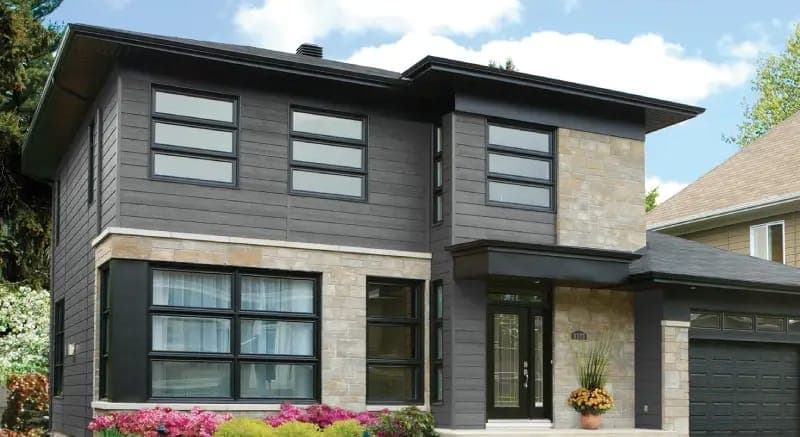
Where LP sells you a substrate and leaves the colour to you, Maibec CanExel sells you a finished board. The coating is a multi coat industrial thermoset from Axalta, cured at high temperature at the plant rather than rolled on a scaffold in October. For a York Region builder trying to close a house before freeze up, removing the paint trade from the critical path is often worth more than the material difference.
The catch is that each profile is locked to an orientation, and getting that wrong is a reorder rather than a fix:
| Profile | Coverage per 12 ft board | Orientation | Colours through Kaycan |
|---|---|---|---|
| Ridgewood D-5 | 11 sq ft | Horizontal only | 8 |
| Ced'R-Vue 9 inch | 7.75 sq ft | Horizontal only | 8 |
| VStyle | 11 sq ft | Vertical or horizontal | 8 |
| Board and Batten | 11 sq ft | Vertical only | 4 |
| UltraPlank | 11 sq ft | Vertical or diagonal, never horizontal | Through Mitten |
Coverage is the number that bites on a takeoff. Ridgewood D-5 and Ced'R-Vue 9 inch look like near neighbours, but at 11 and 7.75 square feet per board they are 42 percent apart. A 2,000 square foot wall needs about 182 boards of D-5 and about 258 of Ced'R-Vue. If you price the job off the wrong one, that gap is real money.
Both are the same 3/8 inch fibreboard at 960 kilograms per cubic metre, and both are certified to ANSI 135.6-2006 and CAN/CGSB-11.5 M87. We stock the CanExel range two ways: through Mitten in the full 18 colour palette, and through Kaycan in an 8 colour selection, with matching CanExel exterior trim either way.
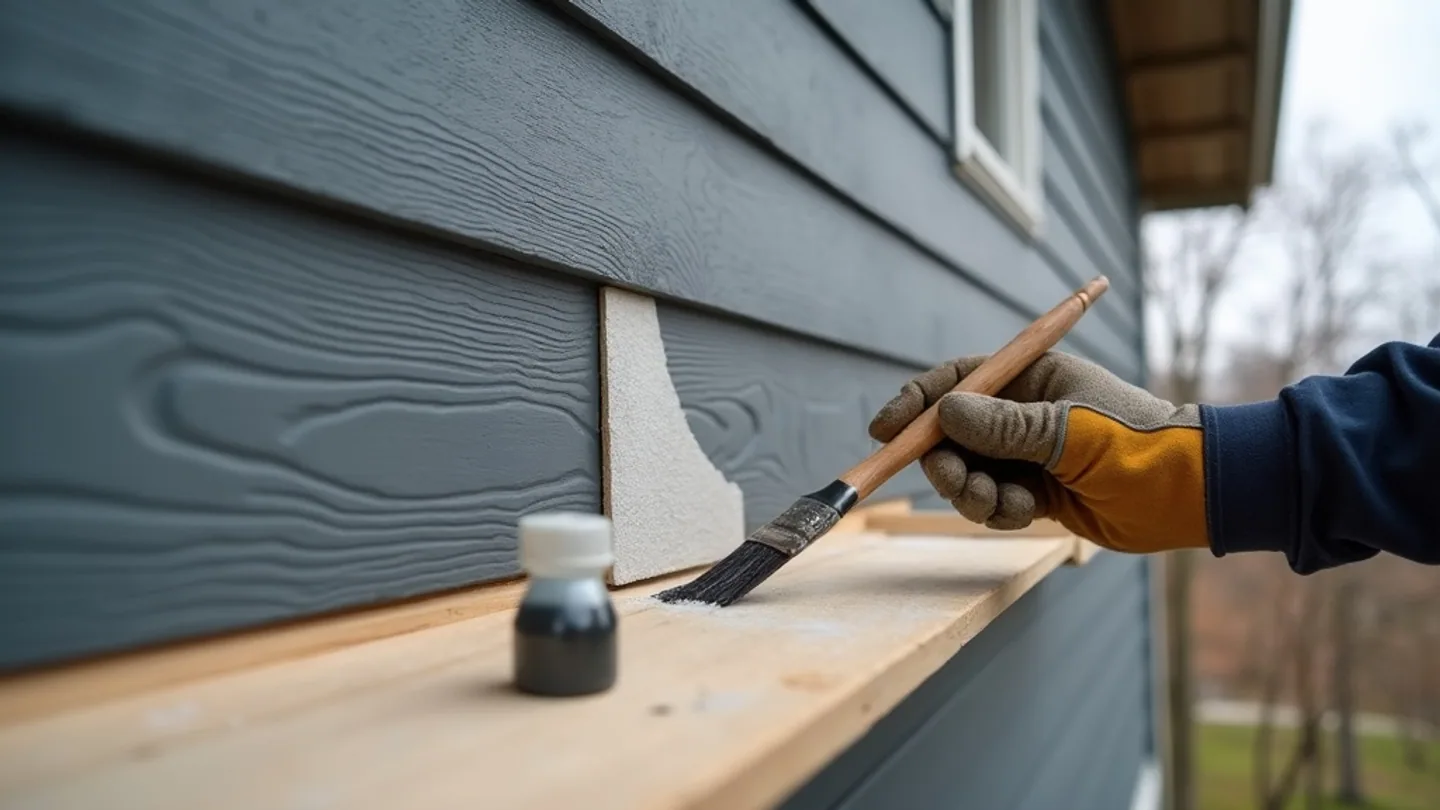 Touch up paint on a cut end is a warranty condition on CanExel, not a finishing nicety.
How Much Does Engineered Wood Siding Cost in Ontario?
Engineered wood siding installs at 9 to 14 CAD per square foot in Ontario in 2026, supplied and fitted. That places it between insulated vinyl and fibre cement, roughly 22 to 25 percent below fibre cement across the range, and it is the reason engineered wood keeps winning jobs where the client wants a wood look and a fibre cement budget will not close.
That repaint cycle is what moves engineered wood down the table in our Ontario siding cost comparison, where it goes from fifth cheapest to install to seventh cheapest to own across thirty years.
| Cladding material | Installed, CAD per sq ft | Reference |
|---|---|---|
| Polymer cedar shake | 5 to 9 | our cedar shake siding guide |
| Standard vinyl | 6 to 9 | our Ontario vinyl siding pillar |
| Aluminum | 8 to 12 | our metal siding guide for Canada |
| Insulated vinyl | 9 to 12 | our insulated vinyl siding guide |
| Engineered wood | 9 to 14 | Ontario installer pricing, 2026 |
| Fibre cement | 12 to 18 | our fibre cement vs vinyl comparison |
Two adjustments belong on any quote built off that table. Labour across the GTA runs roughly 15 to 25 percent above Hamilton and Brantford rates, so a Toronto or Vaughan job sits at the top of the band before anything else is decided. And primed board is not finished board: if you spec LP SmartSide, the paint line goes on the estimate at year zero, while CanExel arrives with the finish already paid for.
Supply pricing is a separate conversation from installed pricing, and it is the one we can actually help with. Send the profile, colour and square footage through our quote request form and we will price the material and the accessories together. We deliver across York Region, the GTA and Simcoe County.
The Ontario Install Rules That Quietly Void the Warranty
Almost every clause that cancels an engineered wood warranty is a storage or detailing rule, not a workmanship judgement. These are the five that we see missed most often on Ontario sites:
-
Store it cold and dry. Keep CanExel out of heated buildings. Heated storage dries the board and makes it prone to buckling. Stack it flat on the supplied pallets or at least 6 inches off the ground and cover it with a water resistant shroud until the day it goes up.
-
Strap the wall. Double furring is mandatory for CanExel in Quebec and the Maritimes and strongly recommended in Ontario. Run vertical furring at least 3/8 inch thick, then horizontal 1 by 3 strapping every 16 inches so the back of the board can dry.
-
Hold your clearances. LP SmartSide requires a minimum 6 inch clearance between the siding and finish grade, a minimum 1 inch clearance above any horizontal surface and at the roof line, and a minimum 1 inch overlap between courses.
-
Nail to the published spacing. LP SmartSide 38 Series is rated to framing at a maximum of 16 inches on centre and 76 Series to 24 inches. CanExel needs at least 1 1/4 inch fastener penetration into stud or strapping, and battens take a nail of at least 2 inches predrilled every 16 inches.
-
Seal every cut and every exposed nail. Touch up paint is mandatory on horizontal cuts in CanExel and strongly recommended on vertical cuts. On LP SmartSide, caulk and seal all exposed face nails, and apply the finish coat within 180 days of installation using 100 percent acrylic latex.
One more, specific to board and batten: never recut a CanExel batten. The factory paint on the edge is part of the moisture barrier, and a site cut removes it. Order the length you need.
Cladding assemblies in Ontario fall under Part 9 of O. Reg. 332/12, the Building Code, and CanExel's own instructions are written to section 9.27 of the National Building Code. The Maibec warranty documents are worth downloading and keeping with the job file, because the storage clauses are the ones an adjuster reads first.
Which Substrate Should You Spec?
Spec LP SmartSide when the framing is on 24 inch centres, when the elevation is long enough that 16 foot boards save real cutting, when hail matters, or when the client wants a colour nobody manufactures. It is the most forgiving of the four to cut and handle, and standard carpentry tools are enough.
Spec CanExel when the schedule cannot absorb a painting trade, when the client has picked a colour from a chip, or when the job is a modern farmhouse and board and batten is the whole design idea. Prefinished is a scheduling decision as much as an aesthetic one.
Spec Allura fibre cement when noncombustibility or a fire rating is in the specification, and accept the weight and the cutting discipline that come with it. We laid out that trade in full in our fibre cement and vinyl comparison.
Spec WPC fluted wall panels when the design calls for a fluted facade rather than lap siding. It is a different product doing a different job, and comparing it to lap on price per square foot is comparing a feature wall to a field.
If the client is really asking for cedar rather than for engineered wood, say so early. Our cedar shake siding guide covers the polymer alternatives, and the Kaycan range guide walks the wider catalogue if you want one manufacturer across the whole envelope. As one Aurora contractor put it to our counter staff last spring: "the siding decision is easy, it is the trim and the schedule that cost me." That is usually right, and the cellular PVC trim guide covers the gap schedule that decides whether those mitres are still shut next July.
Related Products
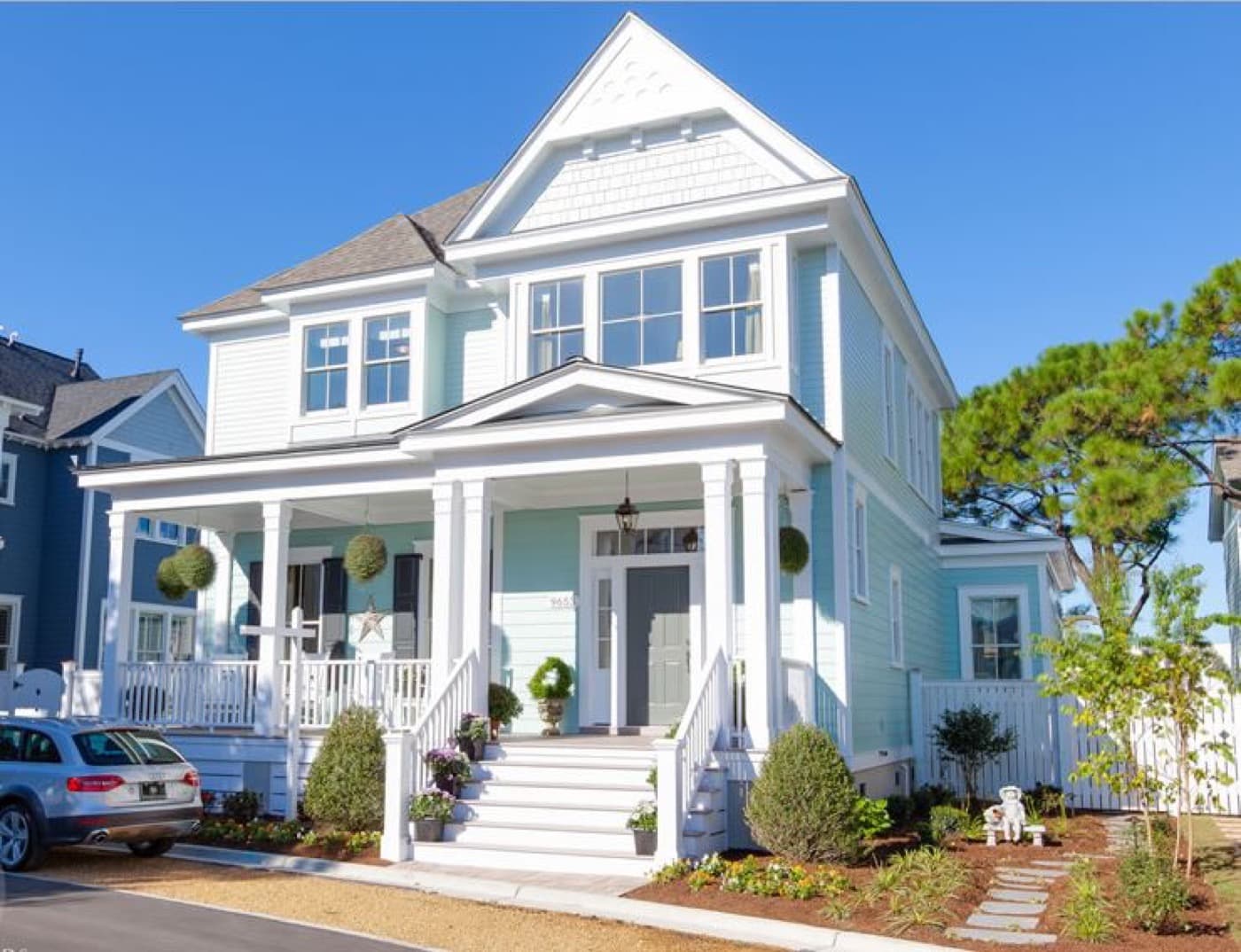

At Pro Materials we stock LP SmartSide and Maibec CanExel at our Newmarket showroom, Unit 5, 1235 Journey's End Circle, alongside the Mitten and Kaycan accessory systems that go with them. Call 905 836 7272 or send the takeoff through and we will price the wall, the trim and the fasteners as one package.
Priya Nair
Building Materials Buyer & Pricing Analyst
Priya manages purchasing and pricing at Pro Materials. She tracks material cost fluctuations across Canadian suppliers and helps contractors understand volume pricing, lead times, and the real cost breakdown of exterior systems.
Share this article