
Exterior House Colours for Ontario Homes: Combinations You Can Actually Order
Key points
- Trim, soffit, fascia and eavestroughs cover 30 to 53% of the cladding on the 12 Ontario house types in our Exterior Studio, 41% on average
- Of the 38 Mitten vinyl siding colours we stock, 19 share a name with a colour in Mitten's vinyl soffit guide and only 7 with an M-Series aluminum colour for fascia and eavestroughs
- Warranty fade limits differ by maker: Mitten allows 3 Hunter units on premium colours and 4 on standard, Kaycan 4, and James Hardie covers more than 4 delta E in the first 3 years
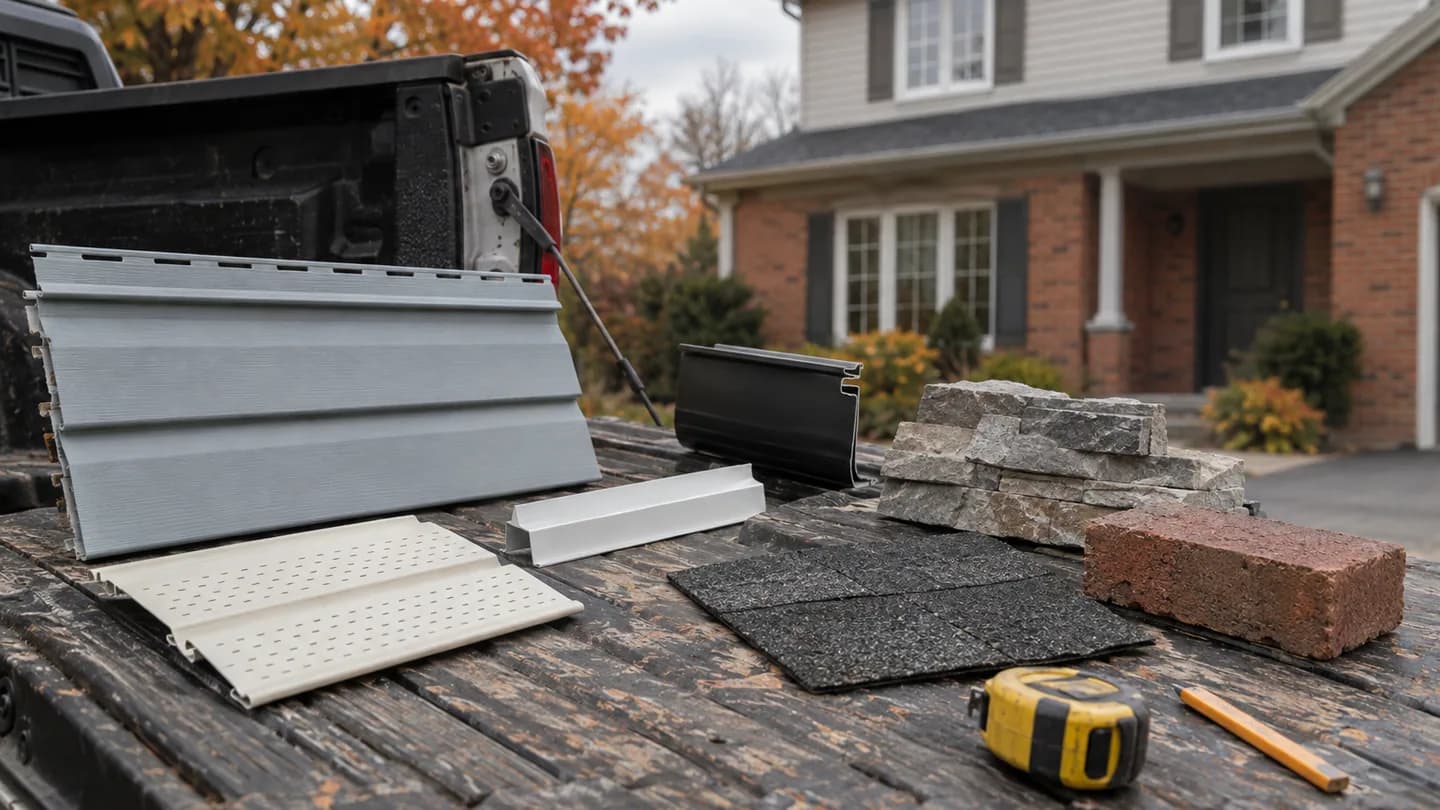
A paint company sells an exterior colour scheme as three chips on a card. A clad house in Ontario is ordered as five or six separate products: siding, trim, soffit, fascia, eavestroughs and downspouts. Each one comes from its own colour list, and most of those lists are much shorter than the siding's. That gap is why exterior house colours picked from a paint deck so often come apart at the quote.
Watch: the parts a house is really made of, which colours carry from the wall to the eave, six schemes you can order, and how much contrast the trim should have.This guide picks exterior house colours the way a clad house is actually bought. It starts with the parts you are keeping, moves to the siding, then works through the shorter lists for the parts around it. Every colour named here is one we stock or one the manufacturer publishes, and every scheme below fits on a single quote. If you are after the 2026 trend colours for vinyl alone, our vinyl siding colours guide covers those. This one is about the whole house.
Why Exterior House Colours Are Five Decisions, Not One
On the 12 Ontario house types in our Exterior Studio, trim, soffit, fascia, eavestroughs and downspouts make up between 30 and 53 percent of the visible cladding, 41 percent on average. Those parts have the shortest colour lists, so they shape a scheme almost as much as the siding does.
Those numbers come from our own tool. The Exterior Studio draws real catalogue products on photos of 12 sample homes, from an 1880s Ontario Gothic farmhouse to a 2020s infill. To do that, every photo is split into parts, pixel by pixel: siding, gables, brick or stone, trim, soffit, fascia, eavestroughs and downspouts. We added up those part masks for the chart below. Each bar is one house front, split by what covers it. Windows, doors, garage doors and the roof are left out, so the percentages are shares of the cladding alone.
- Siding and gables
- Brick or stone
- Trim (counted in Trim to eaves)
- Soffit (counted in Trim to eaves)
- Fascia (counted in Trim to eaves)
- Eavestroughs and downspouts (counted in Trim to eaves)
- Victorian semi1890s53% Trim to eaves
- Muskoka cottage1990s48% Trim to eaves
- Ontario Gothic farmhouse1880s47% Trim to eaves
- Freehold townhouses2010s46% Trim to eaves
- Post-war bungalow1950s44% Trim to eaves
- Subdivision two-storey2000s42% Trim to eaves
- Modern infill2020s41% Trim to eaves
- Modern farmhouse2020s40% Trim to eaves
- Side-split1960s36% Trim to eaves
- Wartime storey-and-a-half1940s35% Trim to eaves
- Two-storey semi1980s35% Trim to eaves
- Raised bungalow1970s30% Trim to eaves
Shares of the cladding visible in each front photo, measured from the part masks the Exterior Studio uses to draw products. The sample homes are AI-generated photos of typical Ontario house types, so read the bars as typical proportions, not a survey of real houses.
Three things stand out:
- The Victorian semi tops the chart at 53 percent. Trim alone covers 30 percent of its cladding: bay window casings, porch posts, corner boards and the gable trim. On a house like that, the trim colour is close to a second body colour.
- Brick pulls the share down, not the importance. The raised bungalow sits lowest at 30 percent because brick covers a third of its front. With less siding to look at, the trim and eaves sit right against the brick, which makes their colour more noticeable, not less.
- Even a plain house is 42 percent frame. The 2000s subdivision two-storey, with no bay windows and almost no masonry on its front, still has trim, soffit, fascia and rainware covering 42 percent of its cladding.
One surface the chart leaves out deserves its own mention: the garage door. On the subdivision two-storey and the modern farmhouse in the Studio, a double garage door is one of the largest single shapes on the front. Treat it as part of the frame. A white garage door ties in with white trim and soffit; under a black fascia and black trim it becomes the brightest thing on the house. If the door is staying, choose the trim with it in mind, the same way you would with brick.
So when the siding colour gets weeks of thought and the rest is left to "whatever goes with it", close to half of what the street sees is chosen by default. Say a homeowner in Aurora re-sides a 2000s two-storey in a warm grey and keeps the builder's white aluminum. The house will look like warm grey with a white outline, a scheme nobody picked. A builder in Bradford planning a dozen semis faces the same arithmetic at street scale.
Start With What Stays: Roof, Brick, Stone and Windows
Before choosing a single exterior house colour, list what is not being replaced. On a re-siding job the roof, the brick or stone and the windows often stay, and their undertones, warm or cool, decide which siding families will look related to them and which will look like contrast.
Kaycan puts the rule plainly in its own advice on mixing siding colours: "it is probably a good idea to stick to similar undertones". Its example is Mocha with Pecan, which work together "since they both have an earthy tone". The same logic runs between new siding and old brick. Red, orange and brown brick are warm. A charcoal shingle roof is close to neutral. Most window frames are white, almond or black, and the trim will sit right against them.
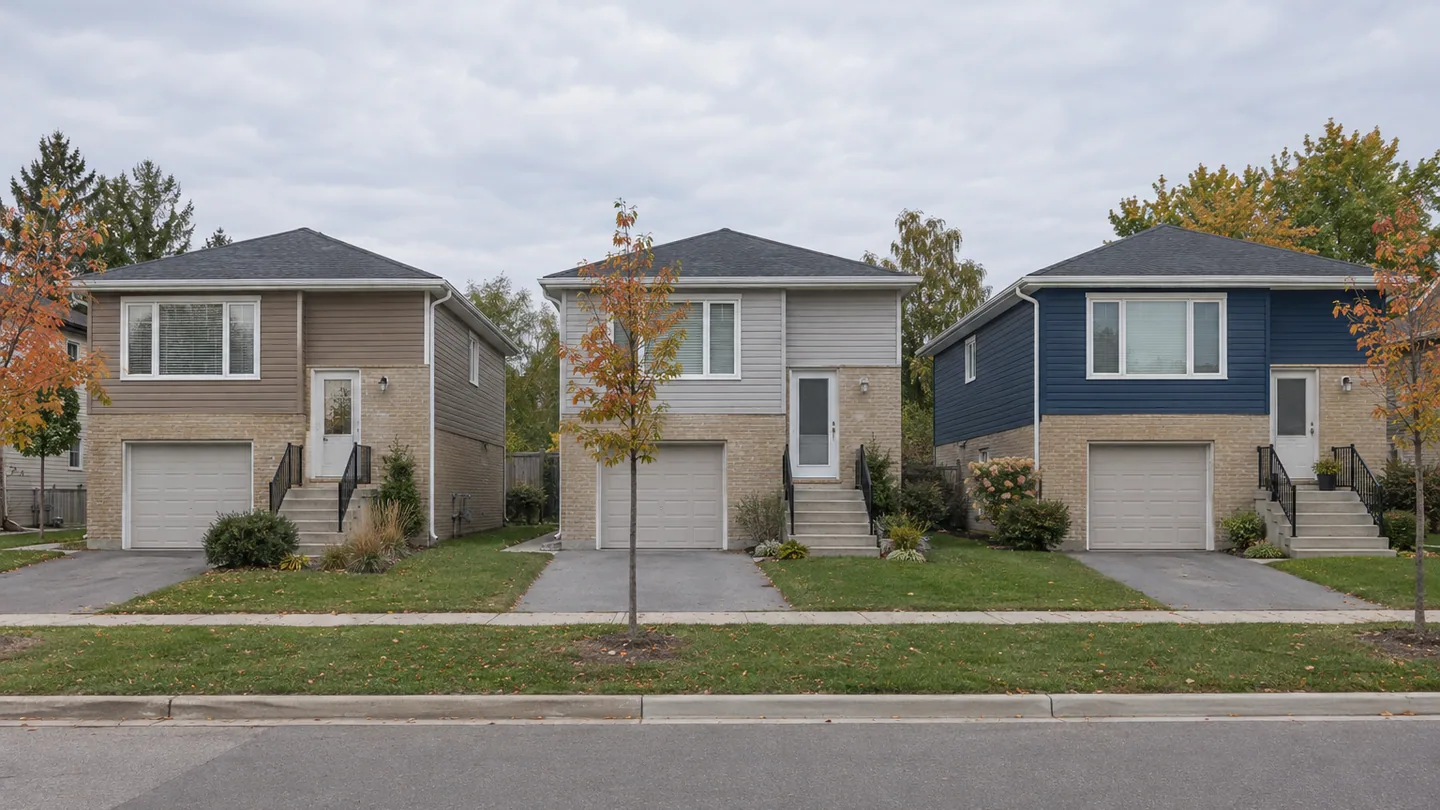 Same tan brick, same roof, three siding colours. The khaki reads as part of the brick's family; the grey and the navy set the upper floor apart from it.
Here is how we read the parts that stay, and where we would start from our own range:
| What stays | What it decides | Where we would start |
|---|---|---|
| Red, orange or red-brown brick | A warm base. Beige, khaki, brown and deep red siding read as one family; grey and blue read as contrast | Mitten Sentry Khaki Brown or Timber Bark, Kaycan Timberlake Khaki or Mocha |
| Buff, tan or yellow brick | A lighter warm base that suits mid-tone neutrals and soft greens | Mitten Hearthstone, Sandcastle or Cypress, Kaycan Sandalwood or Wicker |
| Charcoal or black shingle roof | Neutral, so it takes most siding colours; black fascia and eavestroughs repeat it | M-Series Black or Iron Ore for the eave parts |
| Brown or weathered-wood shingle roof | Warm, so warm siding and brown eave parts look intentional | M-Series Musket Brown, Dark Bronze or Terratone |
| Stone veneer or precast details | Keep the siding inside the stone's own range of tones, so the stone stays the richest surface | GenStone, Novik or Versetta samples held against the siding |
| White, almond or black window frames | The trim sits beside the frame, so the frame colour is part of the trim decision | White frames: white or Bone trim. Black frames: black trim, or a light trim that leaves the frames as the accent |
A contractor re-siding the upper floor of a 1970s raised bungalow in Newmarket is working with a typical version of this. The brick covers a third of the front and is not going anywhere, so the siding is chosen to sit with it. Our stone veneer and Versetta guide covers the opposite job, where the brick is being refaced too and the stone becomes part of the new scheme, and the stone veneer cost guide prices it per square foot.
How Many Colours Does Each Cladding Come In?
Wall products carry the long lists and most of the parts around them carry short ones. In our catalogue, Mitten Sentry vinyl comes in 38 colours and Foundry shakes in 30, while M-Series aluminum has 13, Kaycan K-Snap eavestroughs 6 and Hardie Soffit 5. Stone veneer lines run from 1 to 8 colours.
The material you choose sets the size of the menu before any exterior house colours are on the table. The chart counts the distinct colour names in our own catalogue for a spread of lines of each kind, plus the eave and trim parts that have to go with them. A line with more colours is not better, only wider, but the count tells you how much room there is to fine-tune a shade.
- Vinyl
- Polymer
- Fibre cement
- Aluminum
- Steel
- Engineered wood
- Stone
- Mitten Sentry vinyl siding38 colours
- Foundry Split Shake30 colours
- Kaycan Perfection Shingles28 colours
- Allura fibre cement25 colours
- Kaycan aluminum soffit22 colours
- MAC Polymac steel19 colours
- Hardie Plank fibre cement19 colours
- Kaycan Timberlake vinyl18 colours
- CanExel prefinished siding18 colours
- MAC Norwood steel16 colours
- M-Series aluminum13 colours
- Hardie Trim10 colours
- GenStone stacked stone8 colours
- Mitten Triple 4 vinyl soffit7 colours
- Kaycan K-Snap eavestroughs6 colours
- Hardie Soffit5 colours
Distinct colour names listed for each product in our catalogue on October 24, 2026. James Hardie lists each colour once per texture; it is counted once here. Our listings can differ slightly from a manufacturer's current chart in either direction, so confirm the colour when you order.
Each material also handles colour in its own way, and that matters as much as the count:
-
Vinyl is coloured at the factory, and the fade allowances in the table further down are written into the warranty. Mitten's four vinyl siding lines show how the list depends on the line: Sentry carries 38 colours, Highland 17, Oregon Pride 14 and West Ridge 9.
-
Fibre cement comes two ways. James Hardie's ColorPlus boards are factory finished in a fixed palette, while primed boards take any paint colour on site, as the painter's finish rather than the factory's. Our fibre cement range also includes Allura.
-
Steel from MAC comes in 25 standard colours on its 2026 chart (9 Wood, 4 Signature and 12 Inspiration), and MAC says most standard steel colours on the market "can also be produced upon request". The Norwood profile we stock lists 16 of the standard colours.
-
Stone veneer colours are blends. Each named colour is a mix of tones across the pieces in the box, so a single stone colour covers a range of light and dark. That is why the stone is usually the place to pull the siding and trim colours from, not the other way round.
-
Shakes and shingles come in some of the longest lists in the catalogue. Foundry's polymer shakes list 30 colours and Kaycan's Perfection Shingles 28, which makes them an easy way to add a second colour in a gable. Our cedar shake siding guide compares the profiles.
A homeowner in Barrie choosing between vinyl and steel for a 1960s side-split is really choosing between a list of 38 colours with matching vinyl accessories and a list of 16 with factory paint systems backed by MAC's 40 year warranty. Both can make a good house. They make it with different menus, so look at the list before you fall for one picture.
Which Exterior Colours Match on Soffit, Fascia and Eavestroughs?
Fewer than most people expect. Of the 38 Mitten vinyl siding colours we stock, 19 share a name with a colour in Mitten's vinyl soffit guide and 7 with an M-Series aluminum colour for fascia, eavestroughs and trim coil. James Hardie runs all 19 ColorPlus colours on battens, 10 on trim and 5 on soffit.
The chart below draws every siding colour as a row. A chip in a column means that part comes in a colour of the same name; a dashed ring means it does not. The thread between chips breaks wherever the colour stops, so the colours that can run from the wall to the eave are the long, unbroken ones at the top. Switch the tab to compare Mitten's vinyl system with James Hardie fibre cement.
20 of 38 siding colours carry on to at least one other part. Vinyl soffit: 19. M-Series aluminum: 7.
- BlackSentry, West RidgeAlso on vinyl soffit, m-series aluminum.
- BoneSentry, Oregon Pride, HighlandAlso on vinyl soffit, m-series aluminum.
- BrownstoneSentry, Oregon Pride, HighlandAlso on vinyl soffit, m-series aluminum.
- FlagstoneSentry, Oregon Pride, HighlandAlso on vinyl soffit, m-series aluminum.
- HearthstoneSentry, Oregon Pride, HighlandAlso on vinyl soffit, m-series aluminum.
- StratusSentry, Oregon Pride, HighlandAlso on vinyl soffit, m-series aluminum.
- Arctic GreySentry, West RidgeAlso on vinyl soffit.
- AshSentry, Oregon Pride, HighlandAlso on vinyl soffit.
- Burnt SiennaSentryAlso on vinyl soffit.
- CypressSentry, Oregon Pride, HighlandAlso on vinyl soffit.
- FarmhouseSentry, West RidgeAlso on vinyl soffit.
- FrostSentry, Oregon Pride, Highland, West RidgeAlso on vinyl soffit.
- HemlockSentryAlso on vinyl soffit.
- IndigoSentry, Oregon Pride, HighlandAlso on vinyl soffit.
- NickelSentry, Oregon Pride, HighlandAlso on vinyl soffit.
- Rockaway GreySentry, Highland, West RidgeAlso on m-series aluminum.
- SaffronSentry, Oregon Pride, HighlandAlso on vinyl soffit.
- SageSentry, Oregon Pride, HighlandAlso on vinyl soffit.
- SandcastleSentry, Oregon Pride, HighlandAlso on vinyl soffit.
- Satin GreySentry, Oregon Pride, HighlandAlso on vinyl soffit.
Siding colours: the four Mitten lines we stock (Sentry, Oregon Pride, Highland, West Ridge). Soffit: Mitten soffit buyer’s guide, solid and variegated colours. Aluminum: the 13 M-Series colours; Flagstone is marked Eastern Canada only.
Matching is by colour name within one manufacturer, which is how the order form works. A shared name is our cross-reference, not a manufacturer's promise of an exact match, so compare real samples. Chips are approximate screen colours: Mitten siding and soffit chips use the siding swatch, M-Series chips the hex values in our catalogue, and James Hardie chips the RGB values James Hardie supplies.
Three patterns sit inside the Mitten tab:
-
Every standard colour has a vinyl soffit. Frost, Bone, Sandcastle, Hearthstone, Ash, Brownstone, Satin Grey, Flagstone, Nickel, Stratus, Cypress, Sage, Saffron and Indigo each have a same-name colour in Mitten's soffit buyer's guide, and so does Black. Four of the six Rustic colours do too. Teak and Drift do not. Not every colour in that guide is in our catalogue yet, so ask about the one you need.
-
None of the bold, deep colours has a vinyl soffit. Gunmetal Grey, Annapolis Blue, Muskoka Green, Timber Bark, Coffee Bean and the rest of the deep range stop before the soffit, and only Rockaway Grey reaches the M-Series aluminum. That is not a flaw, just the scheme you are choosing: a deep body with a contrasting soffit.
-
Aluminum is the shortest list. The M-Series comes in 13 colours, and 7 of them share a name with a siding colour: Bone, Hearthstone, Brownstone, Stratus, Flagstone, Rockaway Grey and Black. Mitten's sell sheet marks Flagstone aluminum as "Eastern Canada only". Ontario is covered, but it is worth confirming on the order.
Black is the exception that runs everywhere. Mitten's own sheet for its Black siding says it is "backed by a Lifetime Warranty with matching trims to complement any Mitten colour", and Black is one of the six colours that appear on the siding, the vinyl soffit and the M-Series aluminum by name. That makes it the simplest colour to carry from the wall to the eave, or to use as a frame on any other colour.
Mitten describes the M-Series as "a selection of colours designed to match or complement Mitten vinyl siding" on its M-Series aluminum page. The words "or complement" matter. Some M-Series colours are meant as partners rather than twins: Iron Ore, Dark Bronze, Musket Brown, Terratone, Slate and White have no same-name siding colour at all. The parts that sit tight against the siding are a different story. Mitten's style guide lists "colour matched accessories" among its siding features, and its colour matrix marks which accessories, such as J-channel and corner posts, come in each siding colour.
Kaycan makes a similar promise in different words. Its 2026 catalogue says its aluminum trims and accessories are "colour-matched to Kaycan's aluminum and vinyl siding and soffit", and its product page adds that "not every aluminum trim comes in every color". Its Performance Aluminum Rainware is "available in colours matching Kaycan's exterior siding". One detail shows why we still compare samples. In the same catalogue, Kaycan's Khaki siding carries the colour code 95 and its Khaki aluminum soffit the code 96. Same name, two codes.
Our Kaycan siding guide lists every Kaycan line with its colour count.
James Hardie works the other way round. Every ColorPlus colour comes on the siding and battens, and the list narrows as it climbs: 10 colours on Hardie Trim, 5 on Hardie Soffit. Our James Hardie colours guide goes through that palette one part at a time, including the primed trim that can be painted on site to match a wall-only colour.
The Parts With the Shortest Colour Lists
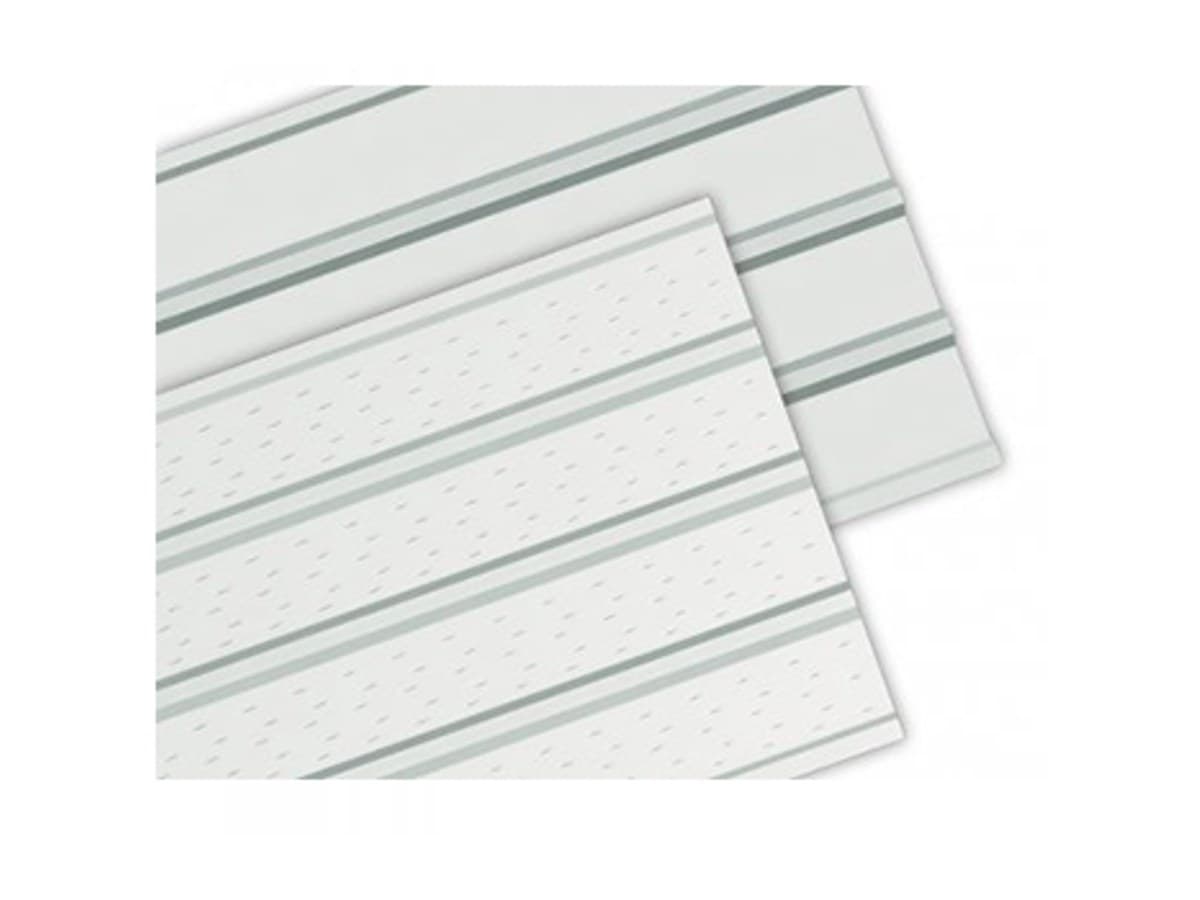

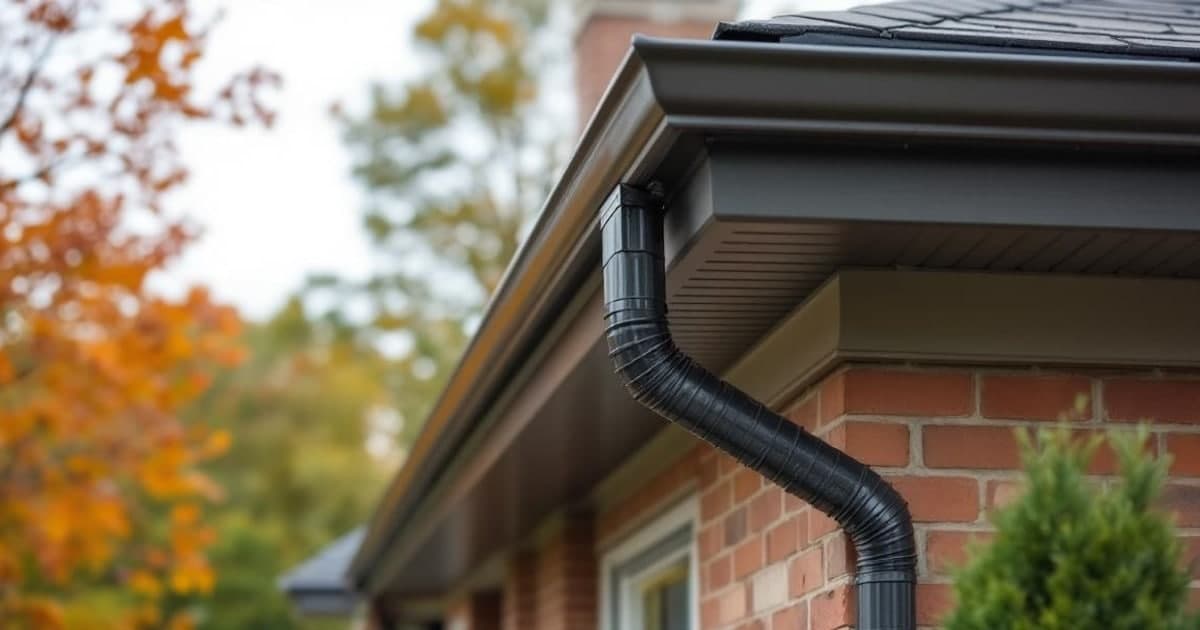

What this means at the counter: choose the siding colour, then look it up on every other part before you settle on it. If it carries through and you want a quiet, all-over house, match. If it stops, pick the contrast now, from the colours that part actually comes in. Our soffit and fascia guide covers vinyl against aluminum for the eave itself, and the eavestrough guide covers sizing and materials for the rainware. The full ranges are on our soffit and fascia, aluminum trim and coil and eavestrough pages.
Six Exterior House Colour Combinations You Can Order
Each scheme below names a real product and colour for every part, all from lines we stock. We drew each one in the Exterior Studio on the sample home whose era suits it, and the button on each card opens that exact scheme so you can change any part or try it on a photo of your own house.
Three rules shaped the six. Every scheme repeats at least one colour on two or more parts, so the house reads as planned rather than assembled. Every one is built from colours that exist for the part they are on, using the lists in the chart above. And between them they cover the main moves: tonal, warm against brick, crisp contrast, deep body with a light frame, and dark on dark.
 01
Matched neutral
2000s subdivision two-storey
One warm neutral carried from the wall through the soffit, fascia and eavestroughs, with a lighter trim to lift the windows.
- Siding
- Mitten Sentry, Hearthstone
- Trim
- M-Series aluminum, Bone
- Soffit
- Mitten Triple 4 soffit, Hearthstone
- Fascia
- M-Series aluminum, Hearthstone
- Eavestroughs
- M-Series aluminum, Hearthstone
Siding to trim lightness gap: 19 (soft frame)
Open in the Studio 02
Khaki and tan brick
1970s raised bungalow, brick stays
A warm mid-tone above warm tan brick, with Khaki repeated on the soffit and the vinyl eavestroughs and a white frame around the upper floor.
- Siding
- Kaycan Timberlake, Khaki
- Trim
- M-Series aluminum, White
- Soffit
- Kaycan aluminum soffit, Khaki
- Fascia
- M-Series aluminum, White
- Eavestroughs
- Kaycan K-Snap vinyl, Khaki
Siding to trim lightness gap: 35 (clear frame)
Open in the Studio 03
White and black farmhouse
2020s modern farmhouse
White board and batten outlined in black: fascia, eavestroughs and trim all repeat the charcoal roof, and the soffit stays white.
- Siding
- Kaycan Board and Batten, White
- Trim
- M-Series aluminum, Black
- Soffit
- Kaycan vinyl soffit, White
- Fascia
- M-Series aluminum, Black
- Eavestroughs
- M-Series aluminum, Black
Siding to trim lightness gap: 98 (strong frame)
Open in the Studio 04
Harbour blue
1940s wartime storey-and-a-half
A deep blue body, which has no same-name vinyl soffit, framed in white on every other part, with white shakes in the dormer.
- Siding
- Mitten Sentry Dutch lap, Annapolis Blue
- Gables
- NovikShake Northern Perfection, White
- Trim
- M-Series aluminum, White
- Soffit
- Mitten Triple 4 soffit, Frost
- Fascia and eaves
- M-Series aluminum, White
Siding to trim lightness gap: 60 (strong frame)
Open in the Studio 05
Dark steel and cedar
2020s modern infill
Dark on dark: Anthracite steel with black trim and eaves, so the cedar-look panel at the entry is the only accent.
- Siding
- MAC Norwood steel, Anthracite
- Accent
- MAC Harrywood PLUS, Cedar
- Trim
- M-Series aluminum, Black
- Soffit, fascia, eaves
- M-Series aluminum, Black
Siding to trim lightness gap: 20 (soft frame)
Open in the Studio 06
Evening Blue Victorian
1890s Victorian semi
With 30 percent of the cladding in trim, Arctic White is close to a second body colour, so the trim was chosen first and the blue second.
- Siding
- Hardie Plank, Smooth, Evening Blue
- Trim
- Hardie Trim, Arctic White
- Soffit
- Hardie Soffit, Arctic White
- Fascia
- Hardie Trim, Arctic White
- Eavestroughs
- M-Series aluminum, White
Siding to trim lightness gap: 45 (strong frame)
Open in the Studio
Pictures: AI-generated sample homes from our Exterior Studio, with the products drawn on by the Studio from catalogue swatch colours. Strip widths follow each sample home's measured part shares. Swatches and lightness gaps are screen values; judge every colour on a real sample.
A few notes on how the six were put together:
-
Matched neutral is the safest scheme on the list. Hearthstone is one of six Mitten colours that run through siding, vinyl soffit and M-Series aluminum by name, so the soffit, fascia and eavestroughs can all match the wall. Bone trim lifts the windows just enough to read.
-
Khaki and tan brick keeps everything warm beside the brick that stays. Kaycan Khaki appears on the siding, the aluminum soffit and the K-Snap eavestroughs. White trim and fascia frame the upper floor without fighting the brick.
-
White and black farmhouse is the highest-contrast scheme you can build, a gap of nearly 98 points on the lightness scale. Black fascia, eavestroughs and trim repeat a charcoal roof. Our board and batten siding guide covers the vertical profiles.
-
Harbour blue puts a deep Bold Premium colour on the body, which has no same-name vinyl soffit, and frames it with white everywhere. The white Novik shakes in the dormer repeat the trim.
-
Dark steel and cedar is dark on dark: Anthracite steel with black trim and eaves, warmed by a Harrywood PLUS cedar panel at the entry. It suits a modern infill, where there is no brick to answer to. Our metal siding guide covers the MAC profiles.
-
Evening Blue Victorian shows why trim colour matters most on older houses. With 30 percent of the cladding in trim, Arctic White Hardie Trim is close to a second body colour, so we chose it first and the wall second.
Mixing brands on one house
Five of the six schemes mix brands: Kaycan siding with Mitten aluminum in two of them, Novik shakes with Mitten siding, MAC steel with Mitten aluminum, and James Hardie fibre cement with Mitten eavestroughs. Only the matched neutral stays inside one brand. Nothing stops a contractor from mixing, and we supply all of them from one counter. What you give up is the shortcut of matching by name, because colour names only line up inside one maker's system. Across brands, judge the pairing by eye and by lightness: either match it closely enough to read as one colour, or set it far enough apart to read as a deliberate frame. White and black are the easiest cross-brand colours, which is why one or the other turns up in five of the six schemes.
How Much Contrast Should the Trim Have?
Measure it as a lightness gap. On the 0 to 100 CIELAB lightness scale, we treat a gap under about 8 points as trim that blends into the wall, 8 to 20 as a soft frame, 20 to 40 as a clear frame, and over 40 as a strong outline. Our six schemes run from 19 points to 98.
Lightness is the one property of exterior house colours you can compare across brands, materials and screens, because it ignores hue. Two colours with a small gap blend at a distance even if one is blue and one is grey. Two with a big gap outline every window, corner and roof edge. The chart shows the siding and trim lightness for each of the six schemes, worked out from the same swatch values as the cards.
Read the extremes first. The farmhouse scheme puts black against near-white, the strongest frame there is, and that is the whole point of the look. The dark steel scheme has a gap of about 20 between Anthracite and black, a soft frame that barely separates the trim from the wall, so the cedar panel becomes the only accent. Both are deliberate. The trouble comes from gaps nobody chose.
Matching soffit and eavestroughs close the gap almost completely. Mitten Hearthstone siding against Hearthstone M-Series aluminum comes out about 5 points apart on our swatch values, and Kaycan Khaki siding against Khaki K-Snap about 6. Both fall under 8, the band where trim blends into the wall, which is exactly what matching is for.
A soft frame works when it is chosen. The matched neutral (19) and the dark steel scheme (20) both keep the trim quiet on purpose. It goes wrong when it happens by accident: a mid-grey siding with a light grey trim that was meant to contrast and ends up neither a match nor a frame. Decide which one you want. For a match, close the gap below 8. For a frame people notice, push it past 20. For a light house with white trim, the PVC exterior trim guide covers the trim boards and mouldings that give the frame some depth.
Accents: Shutters, Columns and the Front Door
The accent is the smallest part of a scheme and the one place exterior house colours can be bold. Kaycan's custom vinyl shutters come in nine decorator colours plus a paintable option, Mitten's in six, and the front door takes any paint colour you like.
On the sample homes in our Studio, gables and accent panels cover between 0 and 14 percent of the cladding, and shutters and the front door are smaller again. That small share is the point: a strong colour that would be too much on a whole wall works on a door and two pairs of shutters. Repeating the accent once, say the shutters and the door in the same colour, is what makes it look planned.
The shutter lists we stock are short and lean traditional:
| Product | Colours in our catalogue | What the maker says about the colour |
|---|---|---|
| Kaycan custom vinyl shutters | White, Clay, Burgundy Red, Musket Brown, Wineberry Red, Forest Green, Tuxedo Grey, Classic Blue, Black, plus Paintable | Moulded-through colour, 40-year transferable warranty on the finish |
| Mitten shutters (sold by Mitten as Novik Shutters) | White, Charcoal, Black, Dark Blue, Heritage Brown, Burnished Slate | Staytru colour technology for UV resistance |
| Alpa vinyl columns and pillars | White, Cashmere, Tan | Vinyl columns for porches and entries |
| Imperial aluminum columns | White, Black | Powder-coated aluminum |
A few pairings that work from those lists. On the Hearthstone scheme, Mitten Dark Blue or Black shutters give the light, tonal house one firm accent. On the Annapolis Blue storey-and-a-half, white shutters would vanish into the trim, so the accent moves to the front door instead. On a red-brick bungalow, Kaycan Burgundy Red or Wineberry Red shutters repeat the brick, which is the same similar-undertone rule Kaycan gives for siding. And on the white farmhouse, black shutters only add to the black already on the fascia and trim, so leaving them off and letting the door carry the colour keeps the front from getting busy.
Dark Exterior Colours in Ontario: Heat, Fade and Reflected Sun
Dark cladding runs hotter. A 2011 Lawrence Berkeley National Laboratory paper cites measured surface temperature differences of about 20°C between white and black vinyl outdoors. Makers answer with heat-resistant formulas and fade warranties, and both the Mitten and Kaycan warranties exclude damage from concentrated or reflected heat.
Kaycan is direct about the problem. Its 2026 catalogue says "darker colours pose a greater challenge, as they absorb more of the sun's rays", and its HELIOS formulation is its answer: in tests its catalogue describes, a heat gun at 176.5°F (about 80°C) left the siding with "no signs of distortion". Mitten makes a narrower claim for its Black siding, a "proprietary black pigment technology" that "allows for cooler performance", with a PVDF film for fade resistance.
Steel and fibre cement do not soften the way vinyl does, but dark exterior house colours still absorb more heat on any material. MAC Metal Architectural publishes solar reflectance values for its finishes: its Onyx Black reflects about 5 percent of solar energy (TSR 0.05) and its Titanium White about 61 percent (TSR 0.61). That gap is the reason dark exterior house colours change how hot a wall gets in July, whatever it is made of.
Reflected sunlight from neighbouring windows
The less obvious risk is sunlight bounced off a neighbour's energy-efficient window. The Polymeric Exterior Products Association (PEPA), formerly the Vinyl Siding Institute, reports a link between low-E glass and damage to exterior materials. Its 2026 paper on concentrated sunlight says "both light and dark colors can be affected" and that the darkness of the siding "appears to be, at most, a secondary factor". On its solar reflection page it adds that the chances on any given house "are extremely small".
The warranties set the boundary. Mitten's excludes damage when "heat sources, such as BBQs, argon gas glass units or other items that can reflect heat over and above 160ºF, are located in close proximity". Kaycan's Canadian warranty excludes "warping or distortion resulting from excessive heat sources or exposure to unusual or excessive reflective sources". On a tight Toronto or Vaughan lot where a neighbour's windows face your wall a few metres away, those clauses matter whatever colour you choose, light or dark.
How each maker defines fading
Every factory colour fades a little. What differs is how much each warranty allows before it counts as a defect. These are the limits in the documents we checked:
| Maker and product | Colour change the warranty allows | Notes |
|---|---|---|
| Mitten vinyl siding, premium colours | 3 Hunter units | Measured to ASTM D2244 |
| Mitten vinyl siding, standard colours | 4 Hunter units | Measured to ASTM D2244 |
| Mitten Rustic siding colours | 1 Hunter unit in the first 5 years, then 2 | Footnote in Mitten's style guide |
| Kaycan vinyl siding, Canada | Over 4 Hunter units counts as more than normal weathering | Measured to ASTM D2244 |
| MAC steel, Textural III (polyurethane) colours | Under 5 Hunter units on walls, 8 on horizontal surfaces, for the first 30 years | Wood-look and Signature colours, including the Anthracite in our steel scheme, are covered as intact and recognizable for 20 years instead; metallic paints are excluded |
| James Hardie ColorPlus | Change of more than 4 delta E units in the first 3 years is covered | Fading from normal weathering is excluded |
A Hunter unit is a measure of colour difference, and a smaller allowance is a stricter warranty. Mitten's split is telling: its premium colours carry a tighter limit than its standard ones. Fading matters most on repairs, where a panel replaced after years of weathering sits beside the originals, so keep a few spare pieces from the original order when a deep colour goes up.
One more caution if you are tempted to paint existing vinyl a darker colour. Fine Homebuilding notes that paint on vinyl usually has to be kept to a light-reflecting value (LRV) of 55 or higher. A darker paint makes the panel absorb more heat than its own factory colour was formulated for. If the goal is a dark house, factory-coloured dark siding is the safer route. Our fibre cement against vinyl comparison weighs the two materials on heat, cost and upkeep.
Do Ontario Heritage Districts Restrict Exterior Colours?
Some do, and the rules differ by district. Heritage conservation district plans in Ontario can limit cladding materials, and some regulate colour, so check with the municipality before ordering if your house is designated or sits inside a district.
Two published plans show the range. The Cabbagetown North district plan in Toronto says no permit is needed for "exterior painting of wood, stucco or metal finishes", while "masonry cleaning and/or painting will require a Heritage Permit". Its guidance for the district's frame cottages is firm on cladding: "modern materials such as vinyl or aluminum siding and Angelstone do not reflect the historic materials used in the District and should be avoided." Its general guidance also discourages synthetic siding on heritage structures.
Markham's Buttonville plan draws the line by class of building. On its Class A heritage buildings, "the use of metal and synthetic sidings such as vinyl is not supported". On its Class B buildings it accepts "cement fibre board, vinyl and aluminium, in configurations and profiles that complement the original design", subject to heritage staff review, calls colours "reflective of the construction period or style of the building" appropriate, and does not support painting brick. Newmarket has its own Lower Main Street South district under By-law 2013-51. If your house is inside a district like these, the heritage planner's answer comes before the colour card.
How to Choose Exterior House Colours for an Ontario Home
Choosing exterior house colours in the wrong order is how a house ends up with siding nobody regrets and an eave nobody chose. This is the order we work through with customers at the counter:
-
List what stays. Write down every part you are not replacing: the roof, the brick or stone, the windows, the garage door and the front door. Note whether each one leans warm (red, orange, brown, beige) or cool (grey, blue, black).
-
Choose the siding line before the colour. Each siding line has its own colour list. Of the four Mitten vinyl lines we stock, Sentry carries 38 colours, Highland 17, Oregon Pride 14 and West Ridge 9, so pick the profile and line first and the colour from that line's list.
-
Check the list for every other part. Look up the siding colour on the soffit, aluminum fascia and eavestrough, and trim lists. Where it carries through, decide whether to match. Where it stops, choose a contrasting colour from the list that part actually comes in.
-
Set the contrast on purpose. Compare the lightness of the siding and the trim. A small gap makes the trim blend into the wall; a large one outlines every window and corner. Pick the effect rather than letting it happen.
-
Try the scheme on your own house. Upload a photo of your house to the Pro Materials Exterior Studio, or pick the sample home closest to yours, and put the real products on each part. Colour changes after the first upload are instant.
-
Look at real samples outside, more than once. Hold the samples against the brick and roof that stay, in daylight, at different times of day. Screens shift colour, and both Mitten and Kaycan tell buyers to judge from real samples.
-
Write every part on the quote. List the product, profile and colour for the siding, trim, soffit, fascia, eavestroughs and downspouts, so nothing is left to whatever happens to be in stock.
Step 5 is where the Exterior Studio earns its place. Upload a photo and the AI outlines the house once. After that, every colour of every product in the Studio swaps in the browser instantly, and you can correct the outline yourself if it missed a corner. When a scheme looks right, the Studio sends it straight to a quote request with every product and colour filled in. For quantities, our siding calculator turns wall measurements into squares and trim runs.
Step 6 is the one people skip. Kaycan's own advice is to "hold up the colour swatches at different times during the day", and Mitten's brochures tell buyers to "refer to actual siding samples before making final decisions". James Hardie's design guide makes the same point about its own colours: they change with the angle of the sun and the amount of sunlight, so only a sample held against your own brick, at more than one time of day, will tell you. The Mitten against Kaycan comparison helps if you are still choosing between the two vinyl systems, the vinyl siding guide for Ontario covers profile and gauge, and the Ontario siding cost guide prices vinyl, steel, fibre cement and engineered wood side by side.
Where to See These Colours in Newmarket
At Pro Materials, we carry every line used in this guide: Mitten and Kaycan vinyl, the M-Series aluminum, Kaycan soffit and K-Snap rainware, James Hardie fibre cement, MAC steel, Novik shakes and stone, and GenStone and Versetta stone veneer. Mitten also offers free samples to Canadian residents through its website, which is handy for a second opinion at home. Our Newmarket showroom has samples to hold against a brick or a shingle you bring in, and the team can tell you which colours are on the shelf and which are a special order. Brand by brand, the ranges are on our Mitten, Kaycan, James Hardie and MAC pages.
To get a price, request a quote with the product, profile and colour for each part, or send a scheme straight from the Studio. We supply the material; our installation partner installs across York Region, the GTA and Simcoe County. Pickup is at the Newmarket counter, and delivery is quoted with the order. Our service areas page lists where we deliver, from Toronto and Mississauga to Barrie and Bradford.
NEWMARKET SHOWROOM Unit 5, 1235 Journey's End Cir, Newmarket, ON L3Y 8T7
Phone: +1 (905) 836-7272 Email: info@promaterials.ca

Ryan Callaway
Vinyl Siding & Cladding Specialist
Ryan has spent 12 years specifying and supplying vinyl siding across York Region and the GTA. He knows every Mitten and Kaycan profile by texture and holds Kaycan's certified product specialist designation.
Share this article